
Blanton’s Original: The Bourbon That Put a Single Barrel in the Spotlight
Stop. Look at the bottle.
There’s a horse on it.
Not a discreet little logo tucked into a corner, either. A full-blown brass racehorse and jockey, charging across the stopper as though someone has just shouted last orders and the Kentucky Derby has suddenly become a matter of personal urgency.
Then there’s the bottle itself: squat, broad-shouldered and unmistakably Blanton’s.
It is, frankly, a lot of theatre for a bottle of bourbon.
But here's the clever part: pour the whiskey and the showmanship starts to make sense.
Because Blanton’s Original isn't famous simply because it looks good on a shelf. Behind that wonderfully eccentric packaging is a bourbon with a rather important place in American whiskey history — one that helped turn the idea of the single-barrel bourbon from an unusual experiment into one of the most coveted styles in the category.
And somewhere inside that bottle is a little bit of Kentucky, a little bit of oak, a little vanilla, a touch of spice... and, if the stories are to be believed, one very good reason to keep the horse facing forwards.
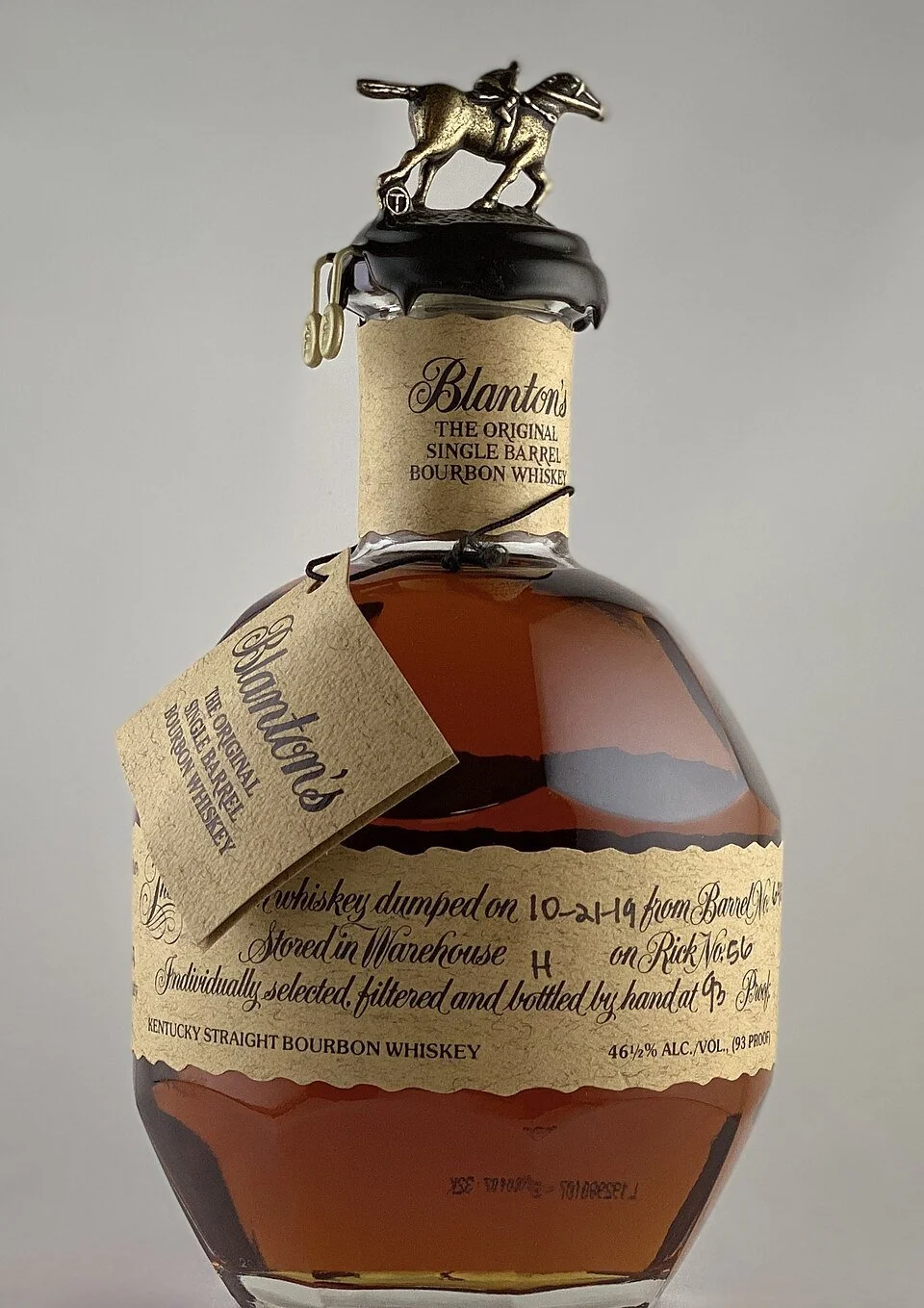
Blanton’s Single Barrel Bourbon — photograph by DixieLiquor, Wikimedia Commons, CC BY-SA 4.0.
A bourbon with a serious pedigree
The Blanton’s story begins at what is now Buffalo Trace Distillery in Frankfort, Kentucky, and particularly with Colonel Albert B. Blanton.
Blanton joined the distillery as a 16-year-old office boy in 1897 and eventually rose to become its president in 1921. According to Buffalo Trace, he was known for selecting particularly prized barrels from Warehouse H to share with distinguished guests and friends. Those so-called “honey barrels” would eventually provide the inspiration for a completely new style of bourbon.
In 1984, Master Distiller Elmer T. Lee turned that idea into a commercial whiskey. Blanton’s was introduced as the world’s first modern single-barrel bourbon, with each bottle drawn from an individual barrel rather than being a marriage of whiskey from numerous barrels.
That may sound commonplace today, but at the time it was a genuine departure. And it helped establish the premium single-barrel category that bourbon drinkers now take for granted.
Welcome to Warehouse H
One of the most intriguing parts of Blanton’s is where it matures.
The bourbon is aged in Warehouse H at Buffalo Trace, a rather unusual structure because it is the distillery’s only metal-clad warehouse. Buffalo Trace says its construction encourages more pronounced temperature fluctuations, promoting a more dynamic interaction between the whiskey and its oak barrels.
That warehouse has become almost as much a part of the Blanton’s story as the bottle itself.
There is something wonderfully romantic about the idea of a whiskey spending years in a Kentucky warehouse, absorbing the seasonal rhythm of its surroundings before eventually finding its way into a bottle.
So, what does Blanton’s Original actually taste like?
At 93 proof — 46.5% ABV — Blanton’s Original is powerful enough to have presence without becoming an endurance test.
Buffalo Trace describes the nose as deep and satisfying, with nutmeg and spice leading the way. On the palate, dry vanilla sits alongside honey, caramel and corn, before the finish brings back the corn and nutmeg. The official Blanton’s tasting profile also points towards citrus and oak, with vanilla, caramel, butterscotch and baking spices adding further dimensions.
And that's where Blanton’s is particularly enjoyable: it doesn't need to shout.
Pour it neat into a decent glass and give it a few minutes. The sweetness arrives first, followed by vanilla and caramel, then the spice starts to build. There is enough oak and peppery character to keep things interesting, but the overall impression remains rounded and inviting.
For a single-barrel bourbon, it is remarkably approachable.
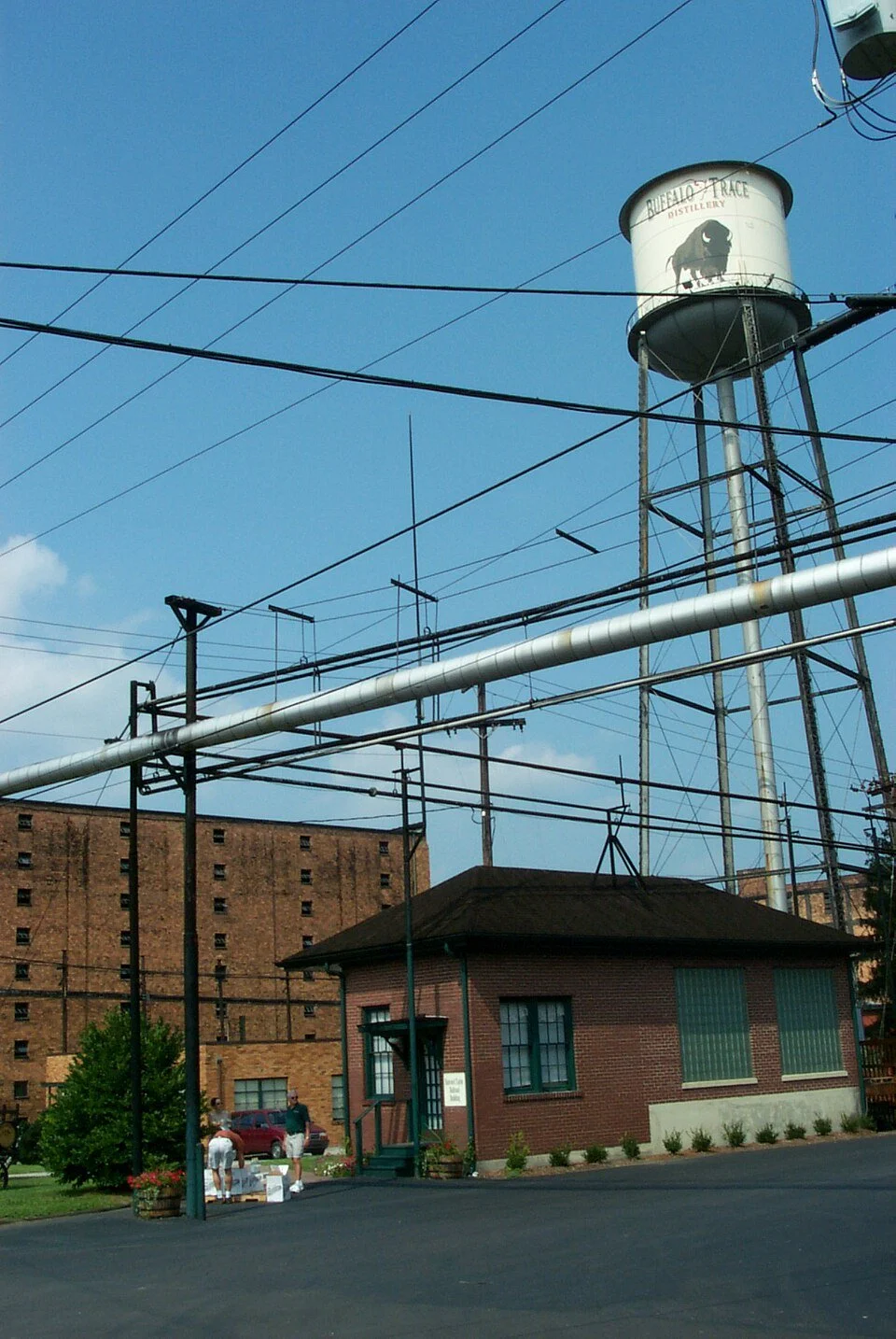
Buffalo Trace Distillery, Frankfort, Kentucky — photograph by Kaplansa, Wikimedia Commons, Public Domain.
The famous horse has a job to do
Of course, we can't talk about Blanton’s without talking about the horse.
Each bottle carries one of eight different horse-and-jockey stoppers. The stoppers represent different stages of a horse race and are individually marked with letters that spell B-L-A-N-T-O-N-S when the full set is assembled. Buffalo Trace says the stoppers are applied at random, which has helped turn them into miniature collector's pieces in their own right.
It's a wonderfully over-the-top bit of bourbon theatre — but somehow it works.
The squat bottle, wax-style presentation, handwritten-looking label details and galloping horse topper give Blanton’s an identity that is almost impossible to confuse with anything else on the shelf.
A bottle worth slowing down for
Blanton’s Original is officially recommended neat or on the rocks, and either approach works beautifully.
Personally, neat is where I'd start.
Take a small pour, let it settle, and give the aromas time to open. Then take a modest sip rather than throwing it straight down. The combination of vanilla, caramel, honey and baking spice is exactly the sort of profile that rewards patience.
And that's perhaps the greatest appeal of Blanton’s.
It isn't merely a bourbon with a famous bottle. It is a little piece of bourbon history — a whiskey born from Colonel Blanton's private-barrel tradition and transformed by Elmer T. Lee into the first modern commercial single-barrel bourbon.
More than forty years after its introduction, the concept remains compelling.
The horse might get your attention, but the whiskey is what makes you pour another glass.
Verdict: A landmark American single barrel that combines history, distinctive presentation and a wonderfully balanced sweet-and-spicy profile. If you're exploring premium bourbon for the first time, Blanton’s Original is one of those bottles that makes it very easy to understand what all the fuss is about.